
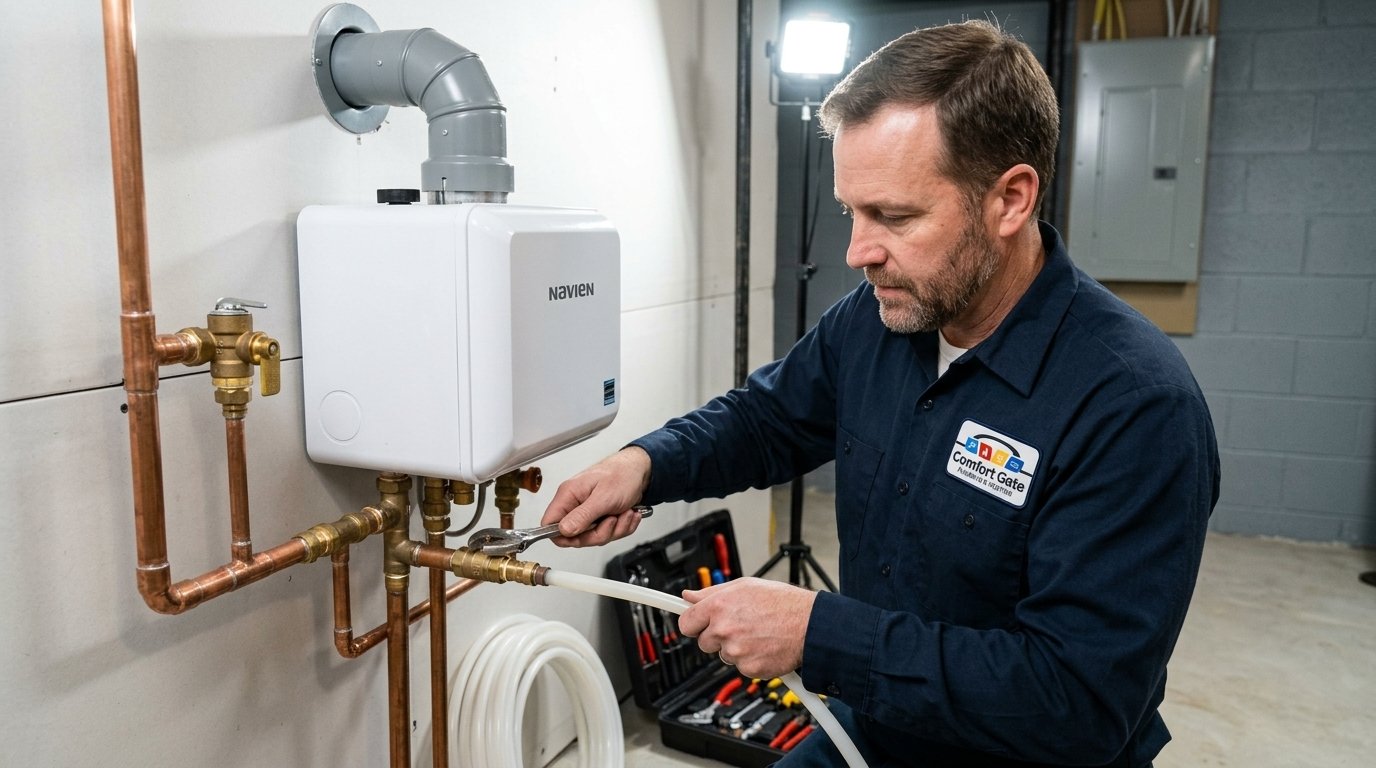
When the time comes to replace an aging or leaking water heater in Burbank, Oak Lawn, Palos Heights, or Cook County, choosing between a traditional storage tank model and a high-efficiency tankless water heater is a major household investment decision.
While traditional storage tanks keep 40 to 50 gallons of water continuously heated 24/7, modern on-demand tankless water heaters heat water instantly as it flows through high-powered heat exchangers, eliminating standby thermal energy loss.
How Traditional Storage Tank Water Heaters Work
Standard water heaters store and continuously heat water inside a large insulated steel tank using natural gas burners or electric heating elements.
Advantages:
- Lower Upfront Cost: Lower initial equipment purchase price and simpler installation requirements.
- Lower Peak Flow Power Demands: Delivers hot water simultaneously to multiple fixtures without demanding large gas line upgrades.
Disadvantages:
- Standby Heat Loss: Burns gas or electricity constantly to maintain water temperature even when everyone is sleeping or away from home.
- Limited Capacity: Running out of hot water after back-to-back showers requires waiting 30 to 45 minutes for the tank to recover.
- Risk of Catastrophic Flooding: Steel tanks corrode over time, creating sudden rupture risks that flood basements.
How Tankless Water Heaters Work
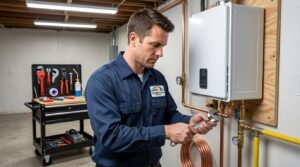
Tankless units operate on demand. When a hot water faucet opens anywhere in your home, cold water flows through a high-efficiency gas heat exchanger, heating water instantaneously to your desired setpoint temperature.
Advantages:
- Endless Hot Water Supply: Never run out of hot water, no matter how many consecutive showers or loads of laundry you run.
- Up to 34% Higher Energy Efficiency: Eliminates standby energy loss, cutting annual water heating utility bills.
- Longer Equipment Lifespan: Operates for 20+ years—double the lifespan of standard storage tanks.
- Space-Saving Design: Wall-mounted units free up valuable floor space in small utility closets or basements.
Detailed Comparison: Tankless vs. Tank Water Heaters
| Feature / Metric | Traditional Storage Tank | On-Demand Tankless Unit |
| Hot Water Supply | Limited to tank size (40–50 gal) | Continuous & Endless |
| Average Lifespan | 8 – 12 Years | 20+ Years |
| Energy Efficiency (UEF) | 0.60 – 0.70 UEF | 0.81 – 0.96 UEF |
| Space Required | Large floor area (5–6 sq ft) | Compact wall-mounted bracket |
| Risk of Water Damage | High (50-gallon tank rupture risk) | Minimal (No stored water) |
Explore our complete range of Water Heater Repair & Tankless Installation Services.
Does installing a tankless water heater require retrofitting gas lines?
Yes, because tankless units heat water instantly, they require a higher BTU firing rate, which often requires upgrading to a 3/4-inch gas line and modern PVC direct-venting pipes.
How often do tankless water heaters need to be descaled?
Due to hard water in Chicagoland, tankless water heaters should be flushed and descaled annually with a non-toxic vinegar solution to remove mineral scale from heat exchangers.