
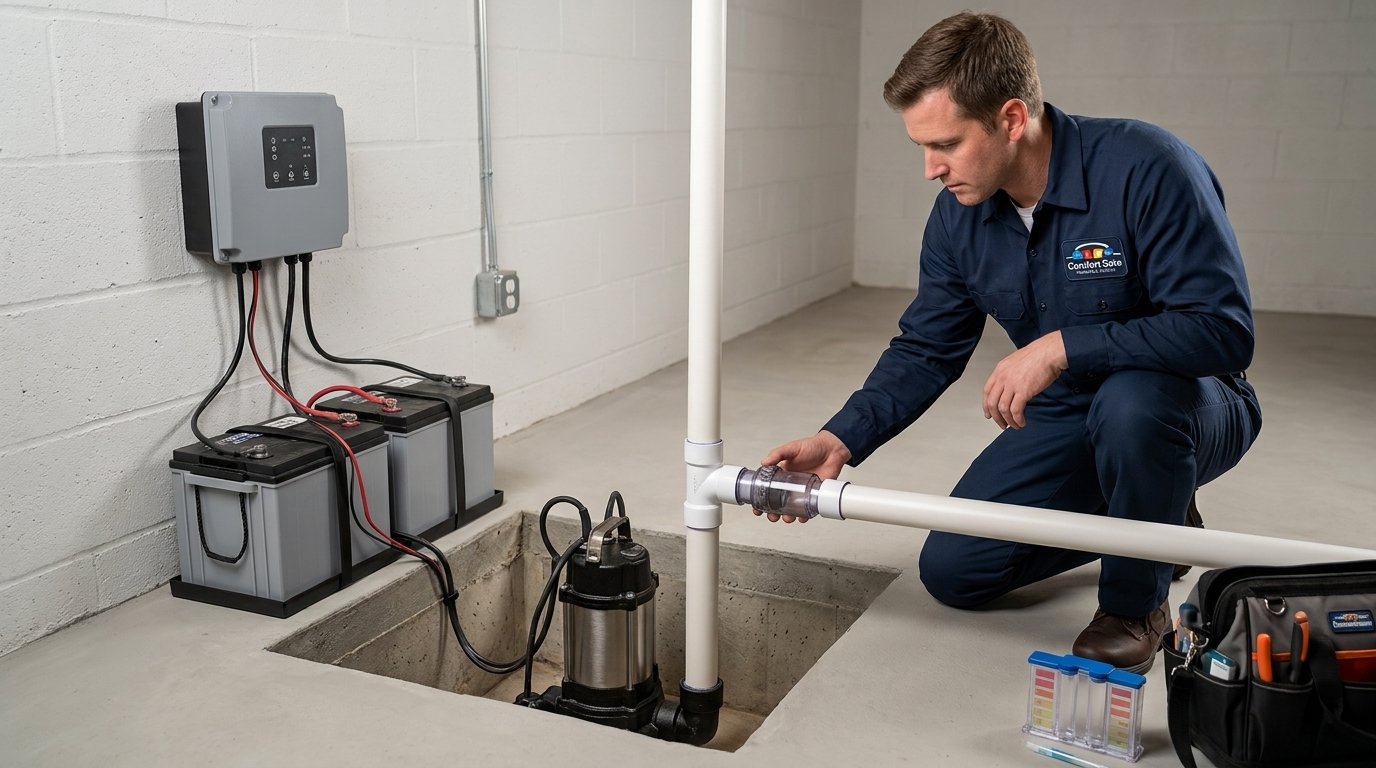
Spring thaws and intense Chicagoland thunderstorms drive massive volumes of groundwater straight into residential foundations. For homeowners in Burbank, Oak Lawn, Palos Heights, and Bridgeview, a properly functioning sump pump system is the primary defense against catastrophic basement flooding.
However, relying entirely on a single AC-powered primary sump pump leaves your property vulnerable when electrical grids fail during severe storms. Upgrading to a secondary battery backup sump pump system ensures continuous water discharge even during prolonged electrical outages.
4 Common Reasons Primary Sump Pumps Fail
Understanding why primary pumps stop working helps you address mechanical risks before water backs up over your basement floor:
- Severe Weather Power Outages: High winds and severe storms frequently knock out electrical power right when heavy rainfall reaches peak intensity.
- Stuck or Obstruction-Bound Float Switches: Mechanical float switches can catch on basin walls or debris, preventing the pump motor from engaging.
- Pump Overwhelm & Mechanical Wear: Standard 1/3-HP pumps often lack the Gallons Per Hour (GPH) capacity required to handle rapid water entry during severe torrential rains.
- Clogged Discharge Lines: Frozen discharge pipes or exterior clogging forces water back down into the basin, overwhelming the unit.
How a Battery Backup Sump Pump System Protects Your Home
A battery backup system operates independently of your home’s main electrical panel. Installed directly alongside your primary pump inside the sump basin, it provides dual-layer flood security:
- Automatic Power Switch-Over: If your electrical power drops out, the backup controller instantly switches power supply to a heavy-duty AGM or marine deep-cycle battery bank.
- Supplemental Flow Assistance: If torrential groundwater influx exceeds the mechanical capacity of your primary pump, the secondary backup pump automatically kicks in simultaneously to double pumping capacity.
- Smart Monitoring & Audible Alarms: Modern backup controllers sound an alert if battery levels drop, charger faults occur, or primary pump failure is detected.
Sump Pump System Comparison Matrix
| System Component | Primary Electric Sump Pump | Secondary Battery Backup System |
| Power Source | Standard 120V Wall Outlet | 12V Heavy-Duty Marine Battery |
| Operation During Outage | ❌ Inoperable (Shuts Down) | ✅ Fully Operational (Up to 72 Hours) |
| Capacity Handling | Primary Capacity (e.g., 3,000 GPH) | Secondary Emergency Flow Boost |
| Mechanical Lifespan | 7 – 10 Years | 5 – 7 Years (Battery replaced per schedule) |
Recommended Maintenance Checklist for Sump Pump Systems
Perform these routine checks every 6 months to ensure reliable operation:
Semi-Annual Sump System Checklist
- Pour Test Basin: Slowly pour 5 gallons of water into the basin to confirm float switch activation and clean motor start.
- Inspect Check Valve: Ensure the one-way check valve on the discharge pipe prevents water backflow into the basin.
- Clean Basin Debris: Remove silt, gravel, and debris from the bottom of the basin to prevent impeller jamming.
- Test Battery Voltage: Verify battery terminal tightness and check status lights on the backup controller.
If your pump is over 7 years old or shows signs of motor strain, explore our complete range of Residential Sump Pump Installation & Plumbing Services.
Secure Your Basement Before the Next Big Storm
Don’t wait for a heavy storm to reveal an unreliable sump pump setup. Our experienced plumbers install high-output cast-iron primary pumps and reliable battery backup systems across Burbank, Oak Lawn, Palos Heights, and Cook County.
Review our specialized emergency services at 24/7 Emergency Plumbing Services.