
Heating and cooling a new home addition, a finished basement, a sunroom, or a detached garage workshop is one of the most significant indoor air comfort challenges for homeowners in Burbank (60459), Oak Lawn, Palos Heights, or Cook County. Extending traditional forced-air ductwork from your main furnace into a new space is frequently expensive, structurally invasive, or completely impractical if your existing HVAC system is not sized correctly to handle the extra load.
Ductless mini-split heat pumps offer an energy-efficient, whisper-quiet alternative, delivering targeted heating and air conditioning directly into individual living spaces without demanding invasive construction or bulky metal ducts.
Ideal Application for Ductless HVAC in Cook County
Ductless technology is uniquely suited for specific home layout scenarios where forced-air systems fall short:
- Home Additions & Finished Basements: Creating independent temperature control for bonus rooms over garages, master suite additions, or basement family rooms without overloading your existing furnace.
- Historic Homes without Ductwork: Many older homes in the Chicagoland radius are heated by boilers and radiators. Mini-splits provide high-efficiency air conditioning and supplemental winter heating without the need to install intrusive ductwork in walls.
- Sunrooms & Bonus Rooms: These areas are prone to extreme temperature variances. Dedicated zoned units can solve localized hot or cold spots instantly.
- Attached or Detached Garages: Convert garage workspaces into year-round usable areas with efficient heating and cooling control.
How Ductless Heating and Cooling Works
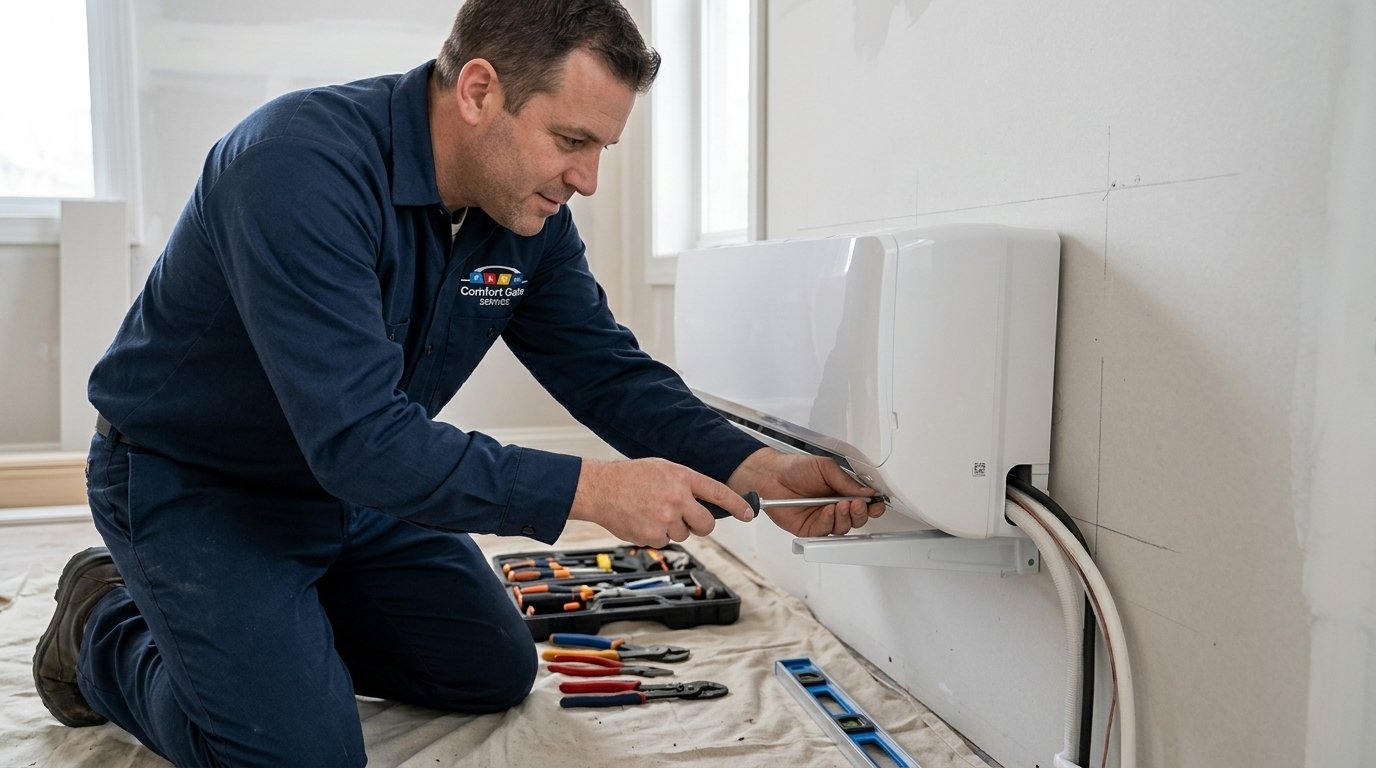
Ductless mini-split systems consist of two primary components: an outdoor inverter-driven compressor/condenser unit and one or more indoor air-handling units mounted on interior walls or ceilings.
Small conduit lines containing refrigerant tubing, suction lines, power cables, and a condensate drain connect the components through a small 3-inch hole through the exterior wall.
- Zoned Air Control: Unlike central HVAC systems that use one thermostat to control the entire house, each indoor mini-split unit features its own thermostat, allowing you to heat or cool only the rooms you are actively using.
- Inverter Compressor Technology: The outdoor unit continuously adjusts motor speeds to match your precise heating or cooling demand rather than abruptly cycling full ON and OFF. This results in incredibly precise temperature control and ultra-low energy consumption.
- Heat Pump Operation: In addition to powerful summer air conditioning, ductless systems reverse operation in the winter, extracting heat energy from the cold outdoor air to provide efficient supplemental heat down to freezing sub-zero temps common in Midwest winters.
Central Forced-Air HVAC vs. Ductless Mini-Split Systems
| Feature / Metric | Traditional Central Forced-Air HVAC | Ductless Mini-Split Heat Pump |
| Ductwork Required | Yes (Invasive metal ductwork network) | None (3-inch wall penetration only) |
| Zone Control | Limited (Unless equipped with damper zones) | Independent room-by-room control |
| Energy Loss (Duct Leakage) | Up to 30% air loss via unsealed ducts | Zero duct loss (Water/Refrigerant lines) |
| Installation Complexity | Drywall repair and structural modification required | Fast 1-to-2 day non-invasive installation |
| Cooling Efficiency (SEER2) | Typically 14 to 18 SEER2 | High (Up to 25+ SEER2 ratings) |
Explore our full lineup of Residential Ductless Mini-Split & Heat Pump Installation Services.
Frequently Asked Questions
Do ductless mini-split heat pumps work during freezing Chicago winters?
Yes, modern high-efficiency hyper-heating inverter mini-splits operate effectively at sub-zero temperatures, providing reliable supplemental heat even when outdoor temperatures drop below -13°F.
How many indoor units can be connected to one outdoor mini-split compressor?
Multi-zone outdoor mini-split compressors can support anywhere from 2 up to 8 individual indoor wall, ceiling cassette, or floor-mounted air handling units, depending on the system BTU capacity.