
Smart Thermostat Installation: Nest vs. Honeywell Guide for Chicagoland Homes
Upgrading from an outdated mechanical or non-programmable thermostat to a modern smart thermostat is one of the easiest ways for homeowners in Burbank (60459), Oak Lawn, Palos Heights, and Cook County to improve daily home comfort while reducing monthly heating and cooling costs.
According to EPA Energy Star estimates, properly configured smart thermostats save homeowners an average of 8% to 12% on heating bills and 15% on cooling bills annually by automatically adjusting home temperatures when you sleep or leave for work.
Google Nest vs. Honeywell Home: Which Smart Thermostat is Best?
While dozens of smart controls exist, Google Nest and Honeywell Home (T-Series / Prestige) lead the residential HVAC market in reliability, smart ecosystem integration, and multi-stage equipment compatibility.
Google Nest Learning Thermostat
- Auto-Scheduling: Learns your temperature preferences over your first week of use and creates an automated schedule.
- Home/Away Assist: Uses phone location data and built-in activity sensors to set energy-saving Eco Temperatures when the house is empty.
- Sleek Modern Aesthetics: Features stainless steel ring finishes and high-resolution glass displays.
Honeywell Home Smart Series (T9 / T10 Pro)
- Precision Remote Room Sensors: Focuses temperature control on active rooms (like bedrooms at night or living rooms during the day) rather than just the hallway where the thermostat is mounted.
- Robust HVAC Equipment Compatibility: Excellent native support for dual-fuel heat pumps, humidifiers, and multi-stage forced-air systems common in Midwest homes.
- Intuitive UI Touchscreen: Familiar interface preferred by homeowners who want manual control without total reliance on smartphone apps.
The Critical “C-Wire” (Common Wire) Requirement
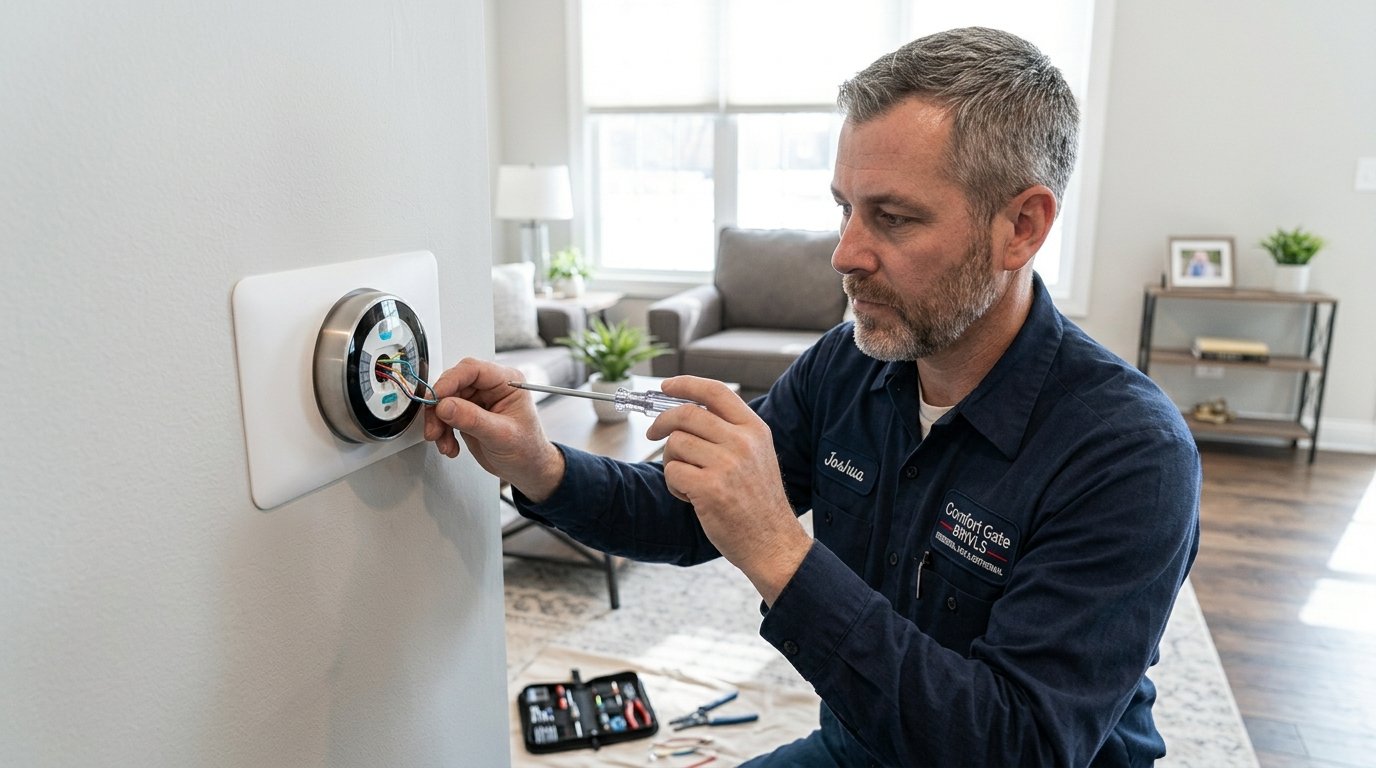
A common installation hurdle in older Chicagoland homes is the absence of a Common Wire (C-Wire) behind the wall. Smart thermostats require continuous 24-volt AC power to run Wi-Fi radios, color touchscreens, and background logic.
Older two-wire or four-wire thermostat cables only carry heat/cool signal currents. Operating a smart thermostat without a dedicated C-wire or C-wire adapter kit leads to Wi-Fi disconnects, erratic furnace short-cycling, or depleted internal lithium batteries.
Smart Thermostat Comparison Matrix
| Feature / Metric | Google Nest Learning Thermostat | Honeywell Home T9 / T10 Pro |
| Primary Advantage | Self-learning scheduling algorithms | Precision remote room temperature/humidity sensors |
| App Ecosystem | Google Home App | Resideo / Honeywell Home App |
| C-Wire Requirement | Strongly recommended (C-Wire Adapter available) | Required (C-Wire Adapter included with pro models) |
| Humidifier / Dehumidifier Control | Supported on Learning models | Native 24V accessory control terminals |
| Smart Home Integration | Google Assistant, Amazon Alexa | Apple HomeKit, Amazon Alexa, Google Assistant |
Explore our full lineup of Residential Smart Thermostat Installation & HVAC Control Services.
Can a smart thermostat be installed without a C-wire in my home?
Yes, by using a C-wire power adapter module installed at the furnace control board or by pulling a new 18/5 thermostat wire bundle from the air handler to the wall cutout.
Will a smart thermostat work with my high-efficiency multi-stage furnace?
Yes, premium smart thermostats support multi-stage gas heating (W1/W2) and multi-stage cooling (Y1/Y2) to maintain variable furnace speeds accurately.