

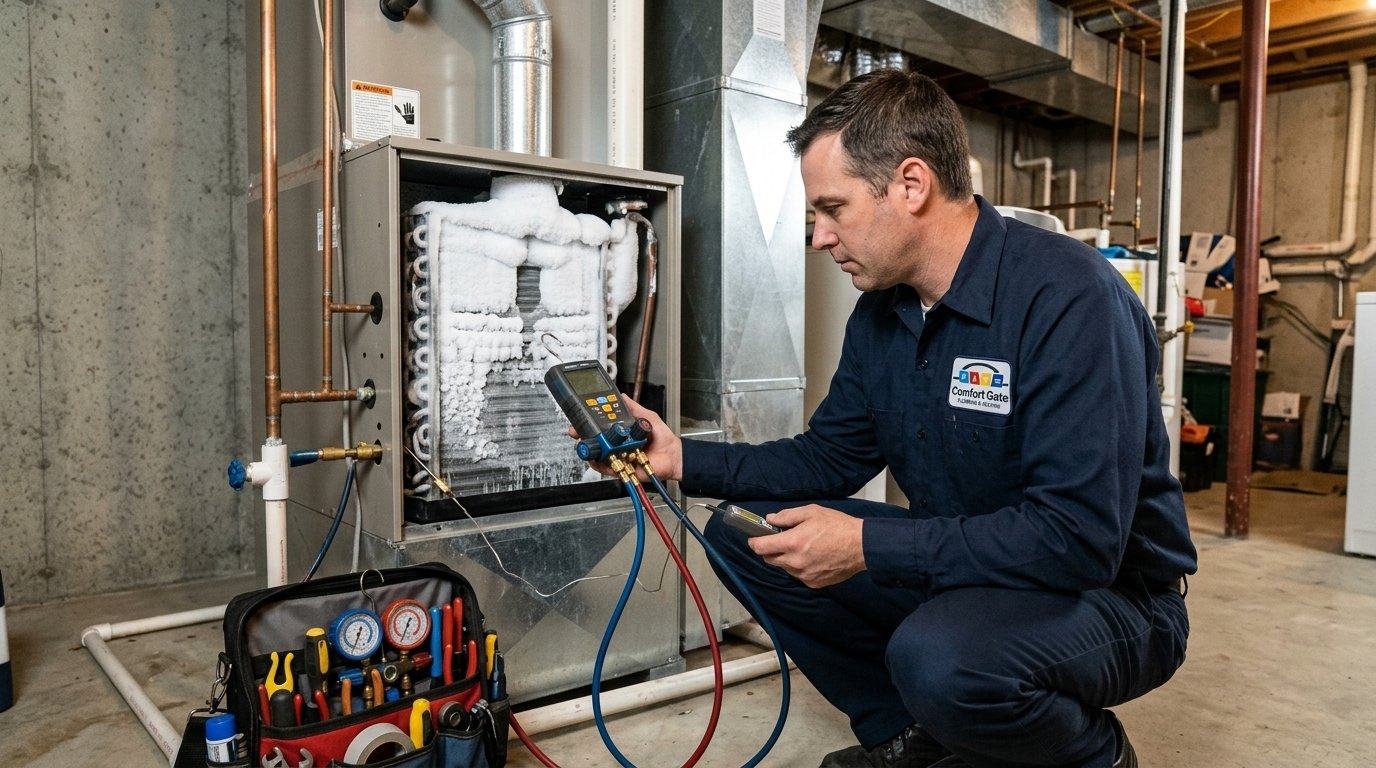
Why Your Air Conditioner is Freezing Up & How to Fix It in Burbank, IL
Discovering a layer of thick ice or frost on your outdoor refrigerant lines or indoor evaporator coil during the humid summer months in Burbank (60459), Oak Lawn, Bridgeview, or Cook County is a common yet serious cooling problem.
When an air conditioner freezes up, it restricts airflow and prevents warm household air from cooling down. Running an AC system with frozen coils can severely damage or burn out the compressor—the most critical and costly component of your HVAC unit.
What Causes AC Evaporator Coils to Freeze?
Air conditioning systems rely on a continuous exchange of heat. Refrigerant flowing through the indoor evaporator coil absorbs heat from household air passed over it by the blower fan. Anything that disrupts this heat transfer causes coil temperatures to drop below freezing (32°F), causing ambient condensation to freeze solid.
1. Restricted Airflow Across the Coils
When airflow drops, there isn’t enough warm air passing over the evaporator coil to heat the cold refrigerant inside. Common airflow restrictions include:
- Heavily clogged or dirty HVAC air filters.
- Blocked, closed, or covered supply vents and return grilles.
- Dirty or dust-caked evaporator coil fins.
- Failing blower motor fan or worn blower belt.
2. Low Refrigerant Levels (Refrigerant Leaks)
A leak in the copper refrigerant lines or evaporator coil reduces internal operating pressure. According to thermodynamic pressure-temperature relationships, lower system pressure drops the refrigerant boiling point below freezing, causing ice to build up exponentially across the coil surface.
3. Dirty Evaporator Coil
Over years of operation, dust, pet dander, and grime settle on wet evaporator coil fins. This layer acts as an insulating blanket, preventing refrigerant from absorbing heat from room air and causing ice formation.
4. Malfunctioning Thermostat or Running AC in Low Outdoor Temps
Running your cooling system when outdoor ambient temperatures drop below 62°F (such as cool summer nights in Chicagoland) drops system pressure and causes coil freezing.
Step-by-Step Emergency Guide: What to Do When Your AC Freezes
If you spot ice buildup on your refrigerant lines or air handler unit, follow these steps immediately to prevent compressor damage:
- Turn OFF the Cooling Mode: Switch your thermostat from “COOL” to “OFF” right away.
- Turn ON the Fan Setting: Switch the fan setting from “AUTO” to “ON”. This forces warm indoor air over the frozen coil to accelerate defrosting without running the compressor.
- Inspect the Air Filter: Check your air filter. If dirty or opaque, replace it immediately.
- Allow Coils to Fully Thaw: Defrosting can take anywhere from 2 to 6 hours depending on ice thickness. Do not scrape or pick ice off the coils manually, as copper fins bend easily.
- Schedule Professional Inspection: If ice re-forms after restarting the system with a fresh air filter, turn off the unit and call an HVAC technician to test refrigerant pressures.
AC Freezing Troubleshooting & System Indicator Table
| Cause / Indicator | Primary Symptom | Professional Repair Solution |
| Clogged Air Filter | Weak air flow from supply vents | Replace filter with proper MERV-rated unit |
| Refrigerant Leak | Hissing sound near coils; frost along copper lines | Leak detection, copper repair, and refrigerant recharge |
| Blower Motor Failure | No air coming from registers while AC is running | Blower motor capacitor replacement or motor rebuild |
| Dirty Evaporator Coil | Water pooling around furnace base during thaw | Chemical coil cleaning and drain pan flush |
Explore our full range of Residential Air Conditioning & Emergency HVAC Repair Services.
Can I run my AC while the coils are thawing?
No. You should turn off the “COOL” mode completely and set the thermostat fan to “ON”. Running the AC while frozen risks liquid refrigerant returning to the compressor, causing severe damage.
How long does it take for frozen AC coils to melt?
Depending on ice thickness, thawing usually takes between 2 and 6 hours. Running the indoor blower fan speeds up the melting process.