
When summer humidity surges across Burbank, Oak Lawn, Palos Heights, and surrounding Cook County, a central cooling system operating at peak performance is essential. Discovering your air conditioner blowing warm air through your vents is a frustrating experience for any homeowner.
This comprehensive guide breaks down why your system loses cooling efficiency, steps to safely inspect your unit, and when professional diagnosis is required.
Table of Contents:
Before booking an emergency HVAC service call, run through these simple preliminary checks:
- Check the Thermostat “Fan” Setting: Ensure the thermostat switch is set to AUTO, not ON. When set to ON, the blower fan runs continuously even when the outdoor compressor cycles off, pushing uncooled ambient air through your home.
- Inspect the Outdoor Breaker Panel: Verify that the electrical breaker controlling your outdoor condensing unit hasn’t tripped. If the indoor air handler runs while the outdoor unit lacks power, warm air will blow through your registers.
- Check the Air Filter: A heavily clogged air filter chokes airflow across the evaporator coil, preventing proper heat transfer and forcing the system to blow warm air.
If basic troubleshooting doesn’t restore cold airflow, your cooling system is likely experiencing one of these five mechanical issues:
1. Restricted Airflow from Dirty Air Filters
A clogged return air filter restricts airflow across the indoor evaporator coil. Without adequate airflow, the coil drops below freezing temperatures, icing over into a solid block of ice that blocks cooling entirely.
2. Refrigerant Leaks in the Sealed System
Refrigerant absorbs heat from your indoor air and releases it outside. If corrosion or vibration creates micro-leaks in copper lines, low refrigerant pressure severely degrades cooling output, causing your ac blowing warm air in Chicago hot spells.
3. Faulty Compressor or Start Capacitor
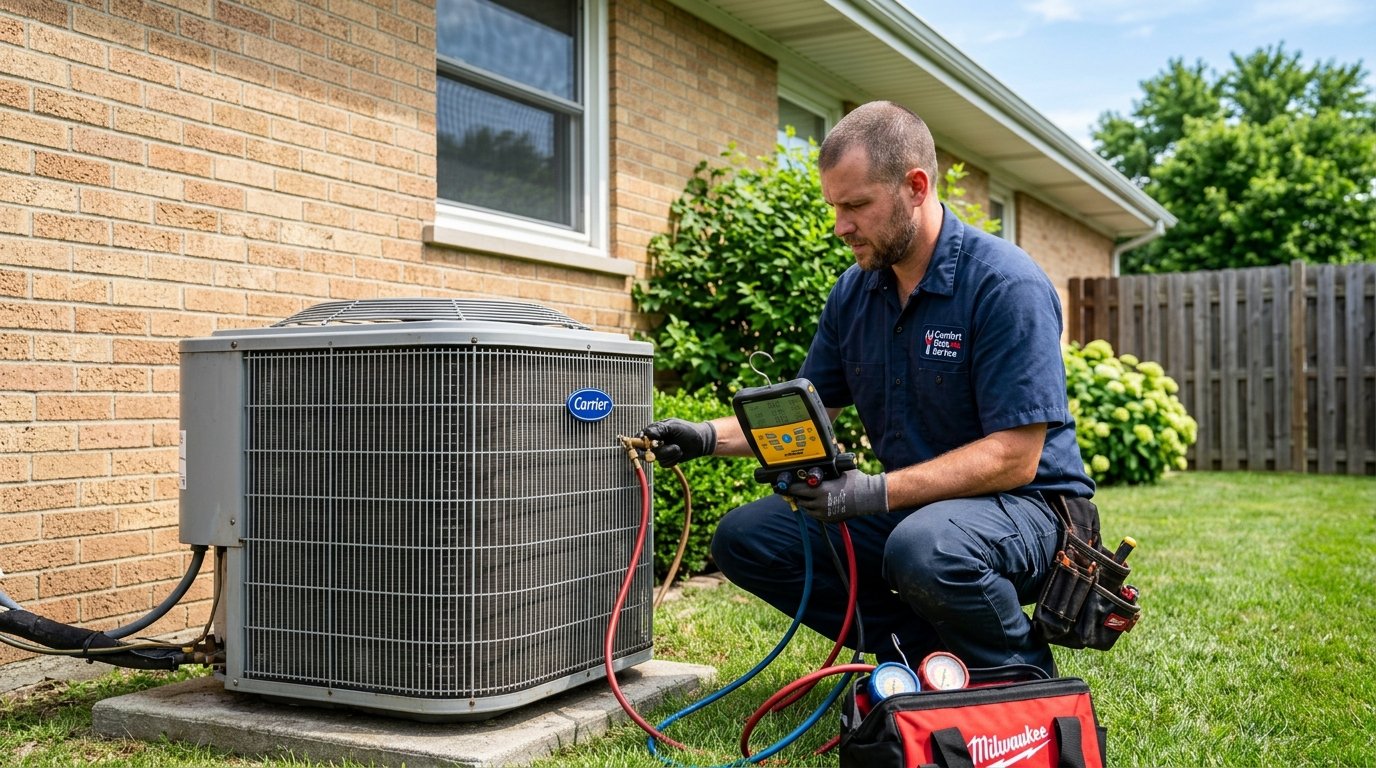
The outdoor compressor compresses refrigerant into a high-pressure liquid. If the dual-run capacitor fails or the compressor motor overheats, the outdoor fan may spin, but the system cannot cool air.
4. Dirty Outdoor Condensing Unit Coils
Leaves, lawn debris, cottonwood seeds, and grime line outdoor condenser fins over time. Restricted airflow prevents the heat transfer process, causing heat to recirculate into your living space.
5. Thermostat Malfunctions or Wiring Short
Outdated thermostats or damaged wiring can break control signals to the outdoor condenser, keeping your AC compressor off while the indoor fan runs.
Use this diagnostic matrix to match symptoms with action steps:
| Observed Symptom | Likely Cause | Recommended Action |
| Indoor fan runs, outdoor unit silent | Tripped breaker or blown capacitor | Check breaker panel; call for electrical AC repair |
| Ice buildup on indoor copper lines | Frozen evaporator coil / clogged filter | Turn system OFF to thaw; replace air filter |
| Continuous warm air blowing | Low refrigerant level or refrigerant leak | Schedule leak detection & refrigerant recharge |
| Outdoor unit dirty / covered in cottonwood | Restricted condenser heat exchange | Shut power off and rinse fins gently with water hose |
When to Call Comfort Gate Service for Professional AC Repair
If replacing your air filter and correcting thermostat settings fails to restore cool air, continuing to run a malfunctioning system can cause permanent damage to your compressor motor.
Our certified technicians provide complete cooling diagnostics, leak detection, capacitor replacement, and coil cleaning across Burbank, Oak Lawn, Bridgeview, and Suburban Cook County.
Explore our full lineup of Residential HVAC & Air Conditioning Repair Services.
Why is my AC blowing warm air when set to cool?
The most common culprits are a thermostat fan set to ‘ON’ instead of ‘AUTO’, a tripped outdoor breaker, a dirty air filter blocking airflow, or a low refrigerant level caused by a leak.
Should I turn off my AC if it starts blowing warm air?
Yes. If your system is frozen or short on refrigerant, continuing to run the AC can overheat and permanently burn out the expensive compressor motor.