

When hot summer weather hits, maintaining a crisp, comfortable indoor climate becomes a top priority. For homeowners looking to upgrade or install a new system, the decision usually comes down to two major contenders: traditional central air conditioning and modern ductless mini-split systems.
Both technologies are highly effective at lowering temperatures and removing humidity, but they operate on completely different mechanical principles. Choosing the right layout depends heavily on your home’s architecture, your budget, and how much control you want over your monthly energy bills.
How Traditional Central Air Keeps the Entire House Cool
Central air conditioning is the most familiar residential cooling option. It relies on a single, powerful outdoor condenser unit that pumps refrigerant to an indoor evaporator coil, usually integrated with your home’s furnace or air handler. This system chills a massive volume of air at a central point and uses a powerful blower fan to force it through a network of supply and return ductwork hidden behind walls and ceilings.
The primary benefit of central air is uniform comfort. Because it distributes conditioned air continuously through existing vents, it maintains a consistent temperature across every single room simultaneously. If your home already features a functional, well-insulated duct network from a forced-air heating system, upgrading to a high-efficiency central air conditioner is often a highly practical, cost-effective choice.
The Rise of Ductless Mini-Splits: Zonal Efficiency
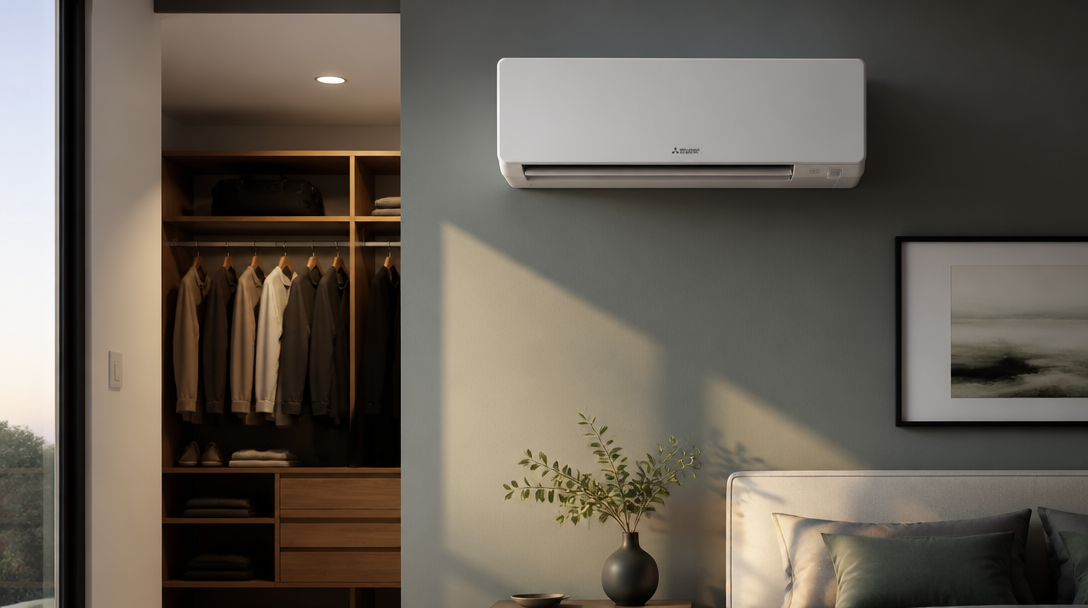
Ductless mini-split systems completely eliminate the need for expansive internal duct networks. Instead, they utilize a smaller outdoor compressor connected directly to one or more compact indoor air handling units mounted high on the walls or flush against the ceilings of specific rooms. These components are linked by a narrow, unobtrusive conduit containing copper refrigerant lines and electrical wiring, requiring only a small three-inch hole through the exterior wall.
The mechanical genius of a mini-split system lies in its capacity for “zoned comfort.” Because each indoor unit operates independently with its own localized thermostat, you possess absolute control over individual rooms. You can keep a sun-exposed upstairs master bedroom perfectly crisp while completely turning off the cooling in a rarely used downstairs guest room, preventing you from paying to condition empty space.
Efficiency Comparison: SEER Ratings and Energy Losses
When evaluating the actual operating costs of these systems, the mechanical differences become highly apparent. Traditional central air conditioning systems are vulnerable to a major flaw known as “duct loss.” Studies from the U.S. Department of Energy indicate that typical residential ductwork leaks, gaps, or poor insulation can cause a home to waste more than 30% of its total cooling energy before the air ever reaches a living space.
Because ductless mini-splits transport chilled refrigerant straight to the individual room handler, they experience zero duct loss, instantly maximizing their thermal performance. Furthermore, many modern mini-split systems are engineered with variable-speed inverter compressors. Instead of turning completely on and off like a standard central AC unit, an inverter system continuously adjusts its speed to match the cooling demand precisely, utilizing a fraction of the electricity required by traditional motors.
Which System Is Right for Your Home?
There is no universal winner between these two options; the ideal choice depends on your specific structural requirements:
- Choose Central Air If: Your home already has a perfectly intact, clean ductwork layout, and you prefer a completely invisible system that maintains a perfectly uniform, identical temperature across every room at all times.
- Choose a Ductless Mini-Split If: You are building a room addition, converting a garage or attic, upgrading an older historic home that lacks space for bulky ductwork, or you want the financial freedom to cool only the specific rooms you use daily to drive down your utility bills.
If you are ready for a full air conditioning replacement, consulting with a certified expert is the best way to calculate the precise load requirements for your home and ensure your upgrade pays for itself in seasonal energy savings.
Optimize Your Summer Comfort
Investing in a high-efficiency cooling system is the most dependable way to combat intense summer heatwaves while keeping your monthly overhead low. Whether you select the whole-home power of central air or the precise, localized efficiency of a ductless mini-split, a professional installation ensures your home remains a cool, energy-efficient sanctuary all season long.